

AI applications from hype to business value
AI-generated editorial illustration; not an actual AO team or client deployment.
AI's value goes beyond generative tools. Explore its history and practical applications, from grounded knowledge assistants to prediction, agents and edge deployments.
Pieter du Toit
Group CEO of AO Group
Generative AI has made artificial intelligence accessible to people who may never have written a line of code. We can now ask a tool to draft an email, explain a document or help build software. That has changed how many of us work. But it has also made it easy to treat AI as a single product, with a single direction of travel.
For a business, the opportunity is broader. AI can help predict demand, identify unusual transactions, inspect equipment, retrieve company knowledge and support decisions. Some applications are emerging quickly. Others have been delivering value for years.
At AO, our view is that organisations should understand this wider landscape before deciding where to invest. The useful question is which application can improve a specific business outcome, and what it will take to make that improvement dependable.
How we arrived here
AI did not begin with ChatGPT. Its history stretches across decades of research, setbacks and practical breakthroughs.
- 1950 — Alan Turing and machine intelligence. Turing’s paper Computing Machinery and Intelligence explored how machine intelligence might be assessed through an imitation game. It helped establish questions that still shape the field today. [1]
- 1956 — AI becomes a research field. The Dartmouth Summer Research Project brought researchers together around the possibility of describing and simulating aspects of intelligence. This meeting is widely recognised as a founding event for AI. [2]
- The following decades — rules, expertise and learning. Researchers developed systems for particular problems, including symbolic reasoning, games and expert decision support. Progress was uneven, with periods when expectations exceeded what available methods and computing resources could deliver. [3]
- The growth of digital data. As organisations and the internet generated more data, machine learning gained more examples from which to identify patterns. Advances in computing and algorithms made increasingly ambitious applications practical. Big data helped accelerate AI; it was not a replacement for it. [3]
- 2012 — a landmark for deep learning. The AlexNet research demonstrated a major advance in image classification using a deep neural network and GPU computing. Deep learning had earlier roots, but this result became an influential milestone. [4]
- 2017 — the transformer architecture. Attention Is All You Need introduced an architecture that became foundational to many subsequent language models. [5]
- 2020 — GPT-3. OpenAI demonstrated a large language model that could perform a range of language tasks from prompts and examples, without separate fine-tuning for each task. [6]
- 2022 — ChatGPT brings conversational AI to a wider audience. Its launch on 30 November made this kind of interaction available through a straightforward chat interface. The initial release used the GPT-3.5 series, rather than the original GPT-3. [7]
These developments accumulated. Better algorithms benefited from more data and stronger computing infrastructure, while easier interfaces brought the resulting capabilities into everyday work.
How long would it take a person to read GPT-3’s source material
The GPT-3 paper lists source datasets totalling approximately 499 billion tokens, and reports training on 300 billion sampled tokens. Those are different quantities: training drew on some sources repeatedly and others only partially. [6]
As an illustration, assume 0.75 words per token and a reading speed of 250 words per minute. Reading the listed source collection would take approximately 2,850 years without stopping. This is an AO calculation using stated assumptions, not a measured reading time; the conversion varies with language and content.
The comparison conveys scale. It does not mean GPT-3 contains an exact, searchable copy of everything in those datasets, or that processing text is equivalent to human comprehension.
Generative narrow and edge AI can work together
It is tempting to describe the future as a sequence from generative AI to narrow AI and then to edge AI. These terms describe different aspects of a system, so the relationship is more useful than a simple succession.
Generative AI describes a capability: creating outputs such as text, images, audio or code. Narrow AI describes scope: performing a defined task or set of tasks. It predates today’s generative tools; a fraud classifier or demand forecasting system is a familiar example. Generative capabilities also do not, by themselves, establish artificial general intelligence. [8]
Edge AI describes where processing happens: on or near the device collecting data, rather than relying entirely on a remote cloud service. It can support both specialised predictive applications and suitable generative models. [9]
A factory could therefore use a specialised vision model to inspect products locally, a forecasting model to anticipate demand, and a generative assistant to explain results to a supervisor. The business value comes from choosing and connecting the appropriate capabilities.
Reading the graph
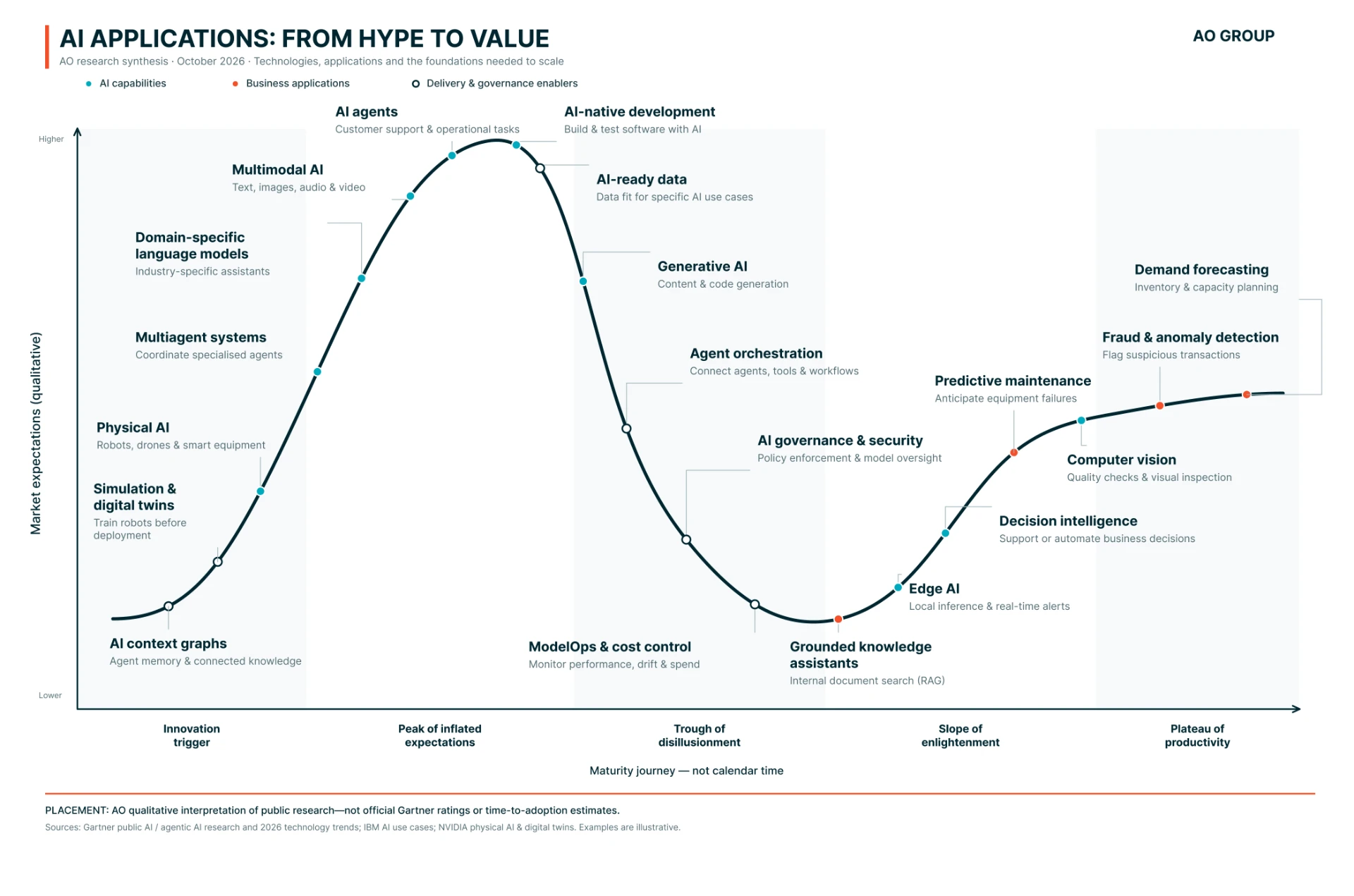
Open full-size graph (PNG, 1920 × 1271 pixels). The same information is set out as text below.
The graph in text
The graph follows a qualitative maturity journey through innovation trigger, peak of inflated expectations, trough of disillusionment, slope of enlightenment and plateau of productivity. Its vertical axis describes lower to higher market expectations. The horizontal axis represents maturity, not calendar time.
It distinguishes AI capabilities, business applications, and delivery and governance enablers. The broad positions below describe the supplied AO illustration; they are not official Gartner ratings, adoption forecasts, measured scores or fixed deadlines.
Labels and broad positions in AO's qualitative AI applications graph:
| Label | Category | Illustrative application or function | Broad position in the illustration |
|---|---|---|---|
| AI context graphs | Delivery and governance enabler | Agent memory and connected knowledge | Early innovation |
| Simulation and digital twins | Delivery and governance enabler | Train robots before deployment | Early innovation |
| Physical AI | AI capability | Robots, drones and smart equipment | Rising expectations |
| Multiagent systems | AI capability | Coordinate specialised agents | Rising expectations |
| Domain-specific language models | AI capability | Industry-specific assistants | Rising expectations |
| Multimodal AI | AI capability | Text, images, audio and video | Rising expectations |
| AI agents | AI capability | Customer support and operational tasks | Near the peak of expectations |
| AI-native development | AI capability | Build and test software with AI | Near the peak of expectations |
| AI-ready data | Delivery and governance enabler | Data fit for specific AI use cases | Just after the peak of expectations |
| Generative AI | AI capability | Content and code generation | Declining expectations |
| Agent orchestration | Delivery and governance enabler | Connect agents, tools and workflows | Declining expectations |
| AI governance and security | Delivery and governance enabler | Policy enforcement and model oversight | Declining expectations |
| ModelOps and cost control | Delivery and governance enabler | Monitor performance, drift and spend | Approaching the trough |
| Grounded knowledge assistants | Business application | Internal document search (RAG) | Around the trough and start of enlightenment |
| Edge AI | AI capability | Local inference and real-time alerts | Early slope of enlightenment |
| Decision intelligence | AI capability | Support or automate business decisions | Slope of enlightenment |
| Predictive maintenance | Business application | Anticipate equipment failures | Slope of enlightenment |
| Computer vision | AI capability | Quality checks and visual inspection | Approaching productivity |
| Fraud and anomaly detection | Business application | Flag suspicious transactions | Approaching productivity |
| Demand forecasting | Business application | Inventory and capacity planning | Toward the plateau of productivity |
Our graph uses Gartner’s Hype Cycle framework to explore the relationship between market expectations and maturity. It shows five recognisable phases: [10]
- Innovation trigger: early developments attract attention before broad commercial proof exists.
- Peak of inflated expectations: excitement and ambitious claims can run ahead of dependable delivery.
- Trough of disillusionment: disappointing implementations expose limitations.
- Slope of enlightenment: workable applications and implementation practices become clearer.
- Plateau of productivity: established uses support more predictable value.
This is different from an adoption S-curve, which describes adoption accumulating over time. Neither approach gives every organisation a fixed timetable. A mature technology may still be difficult to implement in a business with fragmented data, while an emerging application may already work well in a carefully bounded setting.
The positions in our graph are AO’s interpretation. They combine technologies, applications and the foundations required to operate them. They should encourage discussion about readiness and value, rather than serve as a purchasing scorecard.
Where practical AI applications are developing
Gartner’s 2026 strategic trends include multiagent systems, domain-specific language models and physical AI. Its public agentic AI research also highlights the importance of orchestration, governance, security and cost management. [11] [12] These areas help frame a practical business discussion without requiring a prediction about which model will dominate.
Company knowledge that employees can use
A general chatbot may have no access to the current policy, contract or project decision an employee needs. Retrieval-augmented generation, or RAG, connects a generative model with external information, including approved organisational documents. [13]
An internal assistant could help staff find a procedure, understand an approved specification or retrieve a decision from a project record. Reliability still depends on the quality and currency of the sources, access permissions and retrieval performance. The implementation should show its evidence and make uncertainty visible.
Agents that participate in defined workflows
An agent can combine model capabilities with tools to carry out parts of a task. Multiple agents may coordinate different responsibilities, but coordination adds complexity as well as capability. [11] [12]
Consider a proposed supplier-invoice workflow: extract the details, match them against an order, identify differences and prepare an exception for review. It needs explicit rules for permitted actions, escalation and recovery. Human approval can remain part of the workflow, particularly where money or contractual commitments are involved.
Specialisation around an industry or business problem
Domain-specific models focus on the language and requirements of a particular area. [11] For a business, specialisation might also come from approved reference information, connected systems and carefully defined workflows.
A smaller application that performs one valuable task consistently may be a better investment than a broad assistant with unclear responsibilities. The choice should follow measured performance on the organisation’s actual work, rather than model size alone.
Prediction and detection in everyday operations
Predictive AI remains relevant alongside generative tools. Applications include demand planning, detecting suspicious transactions and anticipating equipment maintenance. IBM’s predictive analytics guidance describes these uses across business operations. [14]
These applications deserve evaluation in operational terms. A fraud system needs to balance missed incidents against unnecessary alerts. A forecast should be compared with the planning method it replaces. A maintenance model should help teams make better interventions, rather than simply produce more notifications.
AI operating closer to the point of work
Edge AI can reduce dependence on continuous connectivity and shorten the time between sensing and responding. Local processing may also reduce the amount of data sent elsewhere. [9]
Possible applications include a camera performing quality checks, a device recognising an equipment anomaly or a field tool supporting a bounded task when connectivity is poor. The trade-offs include device capability, power, maintenance and updates. Local execution still needs security and appropriate controls over stored data.
Physical AI and simulation
Physical AI applies intelligence to machines that interact with the real world, including robots and smart equipment. Digital twins and simulation can help teams develop and test systems in virtual environments before deployment. NVIDIA describes this relationship in its industrial digital twin guidance. [11] [15]
A warehouse or production facility could use simulation to examine how an automated system behaves under different conditions. Real-world deployment still requires validation against actual conditions, with appropriate operating and safety controls.
The foundations matter as much as the application
For AO, a useful AI application starts with a clear problem and a realistic understanding of the organisation’s systems. An assistant cannot reliably explain information it cannot retrieve. An agent cannot complete a workflow if the necessary integrations and permissions are missing.
Implementation needs ownership of the data and the process, a defined level of authority for the system, and a way to evaluate results. After deployment, teams need to monitor errors, cost and performance as the underlying business changes.
Governance belongs in this design work. It determines which sources the application can use, who can access the results, what actions require approval and how an incident will be investigated. These choices directly affect whether the application can be trusted in ordinary operations.
Choosing where to begin
A practical starting point is one workflow with a clear owner and a measurable problem. Before choosing a technology, ask:
- What task is slow, costly or producing avoidable errors?
- What data is available, and is it suitable for the task?
- Which steps need prediction, retrieval, generation or conventional automation?
- What happens when the system is uncertain or wrong?
- How will we compare the result with the current process?
For example, an invoice-review pilot might measure review time, exception accuracy and rework. A knowledge assistant might be evaluated on answer correctness, source quality and whether staff can find what they need. Those measures make the decision to expand more concrete.
AI’s history helps explain how today’s capabilities became possible. Its value in a business will depend on how those capabilities are applied. Generative tools, specialised predictive systems and edge deployments can all contribute, often within the same solution.
Our view is that the next stage of enterprise adoption should be judged through useful applications operating reliably in real workflows. That is where an organisation can connect the promise of AI with a result it can measure.
Exploring an AI application for your business? Speak to AO about the problem you want to solve.
Sources and references
- Computing Machinery and Intelligence (opens in a new tab) — Alan Turing
- The research conference where AI began (opens in a new tab) — Dartmouth
- The history of artificial intelligence (opens in a new tab) — IBM
- ImageNet Classification with Deep Convolutional Neural Networks (opens in a new tab) — Krizhevsky Sutskever and Hinton
- Attention Is All You Need (opens in a new tab) — Vaswani and colleagues
- Language Models are Few-Shot Learners (opens in a new tab) — Brown and colleagues OpenAI
- Introducing ChatGPT (opens in a new tab) — OpenAI
- Types of artificial intelligence (opens in a new tab) — IBM
- What is edge AI (opens in a new tab) — IBM
- Hype Cycle methodology (opens in a new tab) — Gartner
- Top Strategic Technology Trends for 2026 (opens in a new tab) — Gartner
- 2026 Hype Cycle for Agentic AI (opens in a new tab) — Gartner
- Retrieval-augmented generation (opens in a new tab) — IBM
- Predictive analytics (opens in a new tab) — IBM
- Industrial facility digital twins (opens in a new tab) — NVIDIA
Research reviewed on 8 October 2026. Application examples and recommendations express AO’s interpretation. The reading-time estimate is calculated from the published dataset quantities using the assumptions stated in the article.
Planning something like this?
Book a Discovery Call with the AO team and we will work through it with you.
Related from AO

How to Measure the Real Business Value of AI
AI’s value goes beyond cost savings. Learn how to measure revenue, productive capacity, faster delivery, better decisions, quality and new opportunities.

Why Cloud Regions, Infrastructure Providers and Sub-processors Matter in Enterprise ERP
Connecting an AI service to an enterprise ERP can create a new international data-processing chain. AO Group examines cloud regions, sub-processors, POPIA, GDPR, encryption, retention and the questions organisations should answer before clicking “Connect”.

Engineering the digital foundations: AO Group's 2035 view
AI may change how we build, bank, work and make decisions. But the digital future still depends on something remarkably physical: more software, more data, more infrastructure and more energy — built around human needs that have changed far less than our technology.